Subnautica 2 Base Building Guide: Layouts, Power, Storage, and Co-op Planning
Good Subnautica 2 base building starts with a short loop between the entrance, oxygen, power, storage, and crafting—not a huge showcase design. Use the starter layout first, then move or expand the base as exploration shifts to new biomes.
- Primary intentBase building and layout
- Best first baseSmall, safe, expandable
- Watch itemEarly Access balance

Quick Answer
Start Small: Oxygen, Power, Storage, and a Return Route Come First
The best early Subnautica 2 base is a compact relay hub near a safe route, not a huge decorative project. Build around four jobs first: a clear entrance for oxygen recovery, reliable power for charging and crafting, labeled storage for materials, and a beacon or landmark that makes the return path obvious. Once those jobs work, expand toward scanner rooms, vehicle support, deeper biome staging, and co-op logistics. This matches the official direction of Subnautica 2 as an underwater survival adventure where players build custom bases, craft tools, and explore alone or in 4-player co-op.
If you are unsure where to build, place a temporary starter base first. A small base that prevents deaths is better than a perfect megabase built too far from food, resources, or the next safe depth step.
Principles
Four Rules Before You Place the First Room
Base building works best when it solves survival problems in order. These rules keep the build useful even before every module is unlocked.
Build near a route, not only a view
A pretty location is useful only if it connects to oxygen safety, materials, and the next biome. Choose a place you can find in bad visibility and return to without checking a map every few seconds.
Keep the first footprint small
A compact hub is easier to power, navigate, and repair. Add rooms only when they solve a real problem such as storage overflow, charging demand, crafting flow, or a deeper route.
Separate survival from decoration
Decorative rooms are fun later, but the first base should make your next dive safer. Put oxygen, power, storage, and crafting where a tired player can use them quickly after returning from danger.
Design labels for co-op
In a 4-player co-op world, confusing storage wastes more time than a missing room. Use short chest or room names, clear beacon labels, and a shared rule for where rare materials go.
Layout
A Practical Starter Base Layout
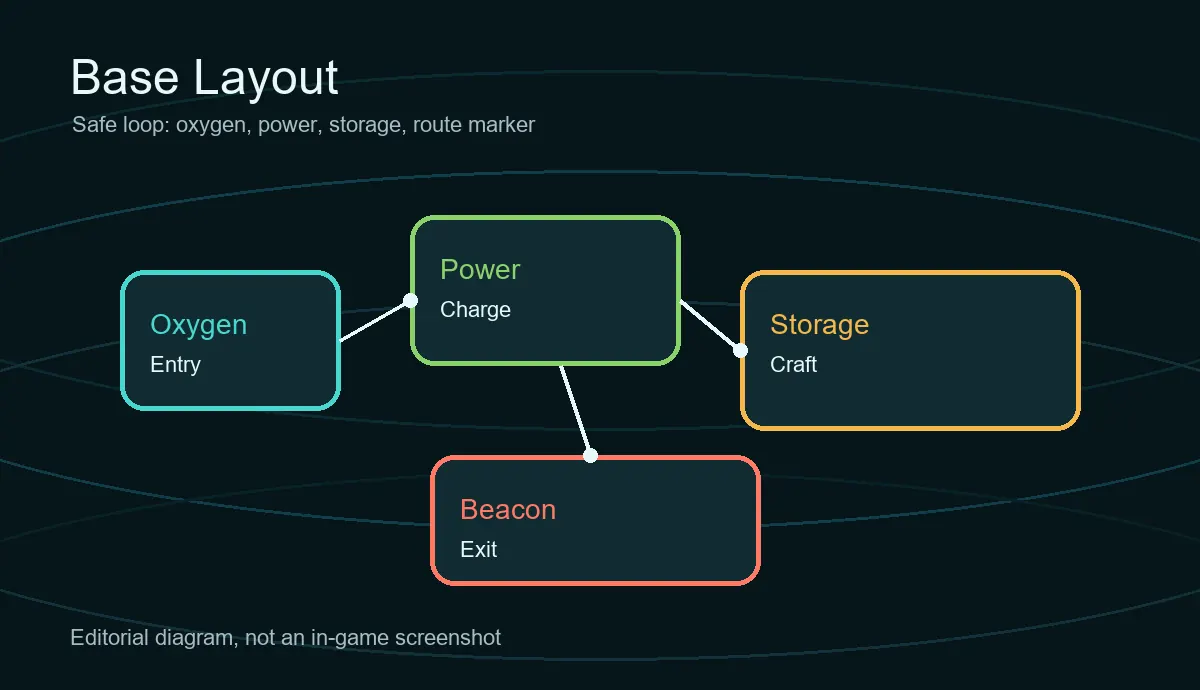
Use a hub-and-loop layout: entrance and oxygen on one side, power and crafting in the middle, storage beside the fabricator, and a beacon or external landmark visible from the route you use most often. The goal is not architectural complexity. The goal is to turn a risky dive into a repeatable loop that ends with charged tools, sorted materials, and a known next objective.
Entrance and oxygen side
Place the entrance where you naturally return from shallow resource runs. If you must swim around the base to enter, the layout is already fighting you.
Power and charging center
Keep power, charging, and crafting close together. When tools are empty after a long dive, the player should not need to search several rooms.
Storage wall beside crafting
Put common materials close to the fabricator and split rare materials into one clearly named place. In co-op, this prevents silent hoarding and duplicated gathering trips.
External route marker
Use a beacon, memorable terrain edge, or light direction so players can find the base after a stressful encounter or night dive.
Priority
Base Module Priority Table
The exact unlock order can change during Early Access, so think in jobs rather than fixed recipes.
| Stage | Modules or jobs | Why it matters | Risk if skipped |
|---|---|---|---|
| Starter | Entrance, oxygen recovery, compact storage, fabricator access | Turns the base into a safe return point instead of a decoration. | Long dives end with panic sorting, low oxygen, and lost materials. |
| Stabilize | Reliable power, charging routine, food and water habit | Keeps tools and survival supplies ready before the next route. | Players leave with dead batteries or forget basic supplies. |
| Expand | Scanner support, route beacons, vehicle or deeper staging area | Connects the base to biome progression and resource discovery. | The base becomes comfortable but does not help progression. |
| Specialize | Co-op storage zones, observation areas, decorative rooms | Makes long sessions easier once survival systems are stable. | Decoration consumes resources before the build solves safety needs. |
Location
Where Should You Build Your First Base?
Do not ask only where the prettiest place is. Ask what the base lets you do ten times safely.
Near a shallow-to-mid-depth transition
A transition point helps the base act as a relay. You can gather safe resources on one side and prepare for deeper runs on the other without rebuilding immediately.
Close enough to resources, not on top of danger
Building directly beside a predator route or narrow ambush cave creates repeated stress. Put the base near materials but outside the behavior zone of hostile creatures.
Visible from multiple approaches
A good location is readable from above, below, and the route you use when escaping. If one wall or ridge hides the base, add a beacon before the first serious expedition.
Expandable without becoming a maze
Leave room for later modules, but keep the core loop simple. If every new room creates another hallway decision, the base will become slower as it grows.
Co-op
How to Build for 4-Player Co-op
Subnautica 2 supports playing alone or with friends, so base building has to handle social friction as well as oxygen. The strongest co-op base is readable: one shared entrance, one storage language, one meeting point, and one rule for who places new modules. If everyone builds in a different style, the base can become a confusing resource sink. Assign jobs early, then rotate them so every player understands power, storage, routes, and emergency exits.
Mistakes
Common Base Building Mistakes
Most weak bases fail because they look planned but do not support actual dives.
Building too far from the route
A beautiful base that takes too long to reach will not be used when oxygen is low. Put the first hub where it shortens repeated trips.
Creating storage with no naming system
Unlabeled storage is a small problem solo and a major problem in co-op. Name by material type, route, or next project so players can act quickly.
Expanding before power is stable
Rooms and devices are only useful when the base can support them. Stabilize power before adding large decorative wings or multiple specialist zones.
Treating Early Access layouts as final
Updates can change recipes, balance, resource density, and performance. Keep the base modular so you can adjust without tearing down the whole plan.
Early Access
Base Details to Recheck After Updates
A good Early Access guide should keep claims flexible and point players to official sources when systems change.
| Topic | What can change | What to do |
|---|---|---|
| Power balance | Generation, drain, module costs, and battery routines may be tuned. | Retest the base after large patches before expanding. |
| Resource density | Material locations can shift, making old base spots less efficient. | Keep route notes and rebuild only if the core loop becomes slow. |
| Co-op stability | Save behavior, reconnects, and version compatibility can affect shared bases. | Choose a host, test reconnects, and avoid major construction during patch confusion. |
| Performance | Large bases can affect frame rate, especially during Early Access. | Expand in stages and test demanding rooms before making them permanent. |
Next Guides
Plan the Rest of Your Survival Setup
After the base loop is stable, connect it to co-op planning, creature risk, hardware readiness, and official update checks.
Subnautica 2 map and biome route guide
Internal
Subnautica 2 multiplayer co-op guide
Internal
Subnautica 2 creatures and leviathans guide
Internal
Subnautica 2 system requirements
Internal
Subnautica 2 base building blueprints guide
Internal
Official Subnautica 2 site
Official
FAQ
Subnautica 2 Base Building FAQ
What should I build first in Subnautica 2?
Build a compact survival hub first: entrance, oxygen recovery, storage, crafting access, and reliable power. Add scanner support, deeper staging, and decoration after the return loop works.
Is a big base better than several small bases?
Not early. A small relay base near a useful route is usually safer than a huge base far from resources. Later, multiple relay points can support deeper exploration better than one oversized hub.
Where is the best first base location?
Choose a place near a safe route, shallow resources, and a transition toward deeper biomes. Avoid building directly inside predator paths or hard-to-see terrain pockets.
How should co-op groups organize a base?
Use one shared storage language, clear beacon labels, a known meeting point, and assigned jobs for building, logistics, scouting, and maintenance. Confusing labels cause more waste than missing rooms.
Will base building change during Early Access?
It can. Recipes, power balance, resource density, performance, and co-op behavior may change through updates, so keep the first base modular and recheck official notes after major patches.
When should I move my base in Subnautica 2?
Move or add an outpost when travel time becomes the main risk and the resources or next biome are far from your current base. Build a small oxygen, power, and storage core at the new location before dismantling the old base.