Subnautica 2 Creatures Guide
Use this guide to read Subnautica 2 creature encounters before you swim into them: which animals are harmless, which ones deserve distance, how to scan without losing the route home, and why every creature list needs an Early Access caution label.
- IntentCreatures, enemies, leviathans
- Best useScan and survival planning
- Update riskEarly Access balance changes
Quick Answer
Subnautica 2 Creatures Are Not Just Collectibles
The best way to approach Subnautica 2 creatures is to treat every new animal as both information and risk. Small passive life can mark safe resource pockets, territorial creatures can turn a shortcut into a trap, and larger predators or leviathan-class threats should be handled like route blockers until you understand their patrol space. Because Subnautica 2 is in Early Access, the exact creature list, names, spawn density, aggression range, and balance can change. Build your own creature notes around behavior you can verify in game rather than assuming an old video or a copied list is final.
For the first hours, scan from the edge of a biome, keep the return route visible, mark dangerous zones with beacons, and only chase a full scan when oxygen, food, battery charge, and escape direction are under control.
Creature Types
How to Classify a New Creature Before You Know Its Name
A useful creature guide is not only a list of names. It helps you decide what to do while the animal is still unknown.
Passive wildlife
Passive animals are the safest first scans. Watch whether they flee, cluster near resources, or react to light and sound. Even harmless creatures can reveal where food, crafting materials, thermal vents, or shelter routes are likely to appear.
Defensive or territorial life
A creature that circles, charges, warns, or guards a narrow path should be logged as territorial until proven otherwise. Do not force a scan from the front; observe from the side, measure its turn radius, and keep an escape line behind you.
Ambush threats
Ambush creatures are dangerous because the first warning can arrive late. If an area has low visibility, sudden sound cues, damaged terrain, or scattered resources in an exposed pocket, assume it may be designed to pull you away from safety.
Leviathan-class encounters
Leviathan searches usually mix curiosity and spoilers. Treat anything enormous, loud, persistent, or biome-defining as a route problem first and a collectible scan second. The safest win is often marking the edge and returning with better mobility.
Creature List
Subnautica 2 Creature Risk List for Early Access
This table uses safe, behavior-first labels where the live game or patch notes should be checked before relying on a final name list.
| Creature or group | Role in the ocean | Risk level | What to do |
|---|---|---|---|
| Small passive fauna | Food-web signal, safe-biome texture, and early scanning practice. | Low unless you follow it into depth or poor visibility. | Scan one near oxygen safety, note what resources share the area, and avoid chasing schools away from your return point. |
| Resource-area guardians | Creatures that make useful material pockets feel risky or time-limited. | Medium because greed can keep you in the area too long. | Collect in short loops, place a beacon, and return later with better air or storage instead of clearing the area in one dive. |
| Hammerhead behavior watch | A named behavior point from Early Access hotfix notes, useful for tracking balance changes. | Patch-dependent; aggression and pathing may change. | Check current patch notes before treating old behavior as reliable, then test from the edge of its range. |
| Ambush predators | Threats that punish narrow caves, low visibility, and distracted scanning. | Medium to high depending on oxygen and escape space. | Enter with a full tank, face the exit before scanning, and leave immediately if audio or movement cues stack up. |
| Leviathan-class threats | Major biome danger, spoiler target, and route blocker for deeper exploration. | High until patrol range, damage, and escape options are understood. | Do not chase the scan on first contact. Mark the boundary, retreat, prepare mobility and repair options, then return deliberately. |
For live release state, official store labels, and Early Access context, verify the official Steam listing.
Current build checks
Read creature names and leviathan claims safely
Search demand around "Subnautica 2 creatures" and "leviathan Subnautica 2" is high enough to answer, but exact encounter details can change during Early Access.
| Topic | Safe reading | Player action |
|---|---|---|
| Creature names | Treat named lists as patch-sensitive unless they come from the current build or official media. | Use this guide for behavior categories, then verify names in your in-game PDA or official notes. |
| Leviathan sightings | Large-threat preparation is useful, but exact spawns are spoiler-heavy and may be rebalanced. | Mark dangerous routes with beacons and avoid publishing your own map until you recheck the latest build. |
| Co-op scanning | More players can scan faster, but noise, oxygen use, and split routes increase failure risk. | Assign one scanner, one lookout, and one route marker before entering unknown predator water. |
| Patch changes | Aggression, resource adjacency, and biome density can change between updates. | Revisit the Steam page and Unknown Worlds updates after every major patch. |
Official reference for the current product state: Subnautica 2 on Steam.
Risk Matrix
Read Behavior Before You Read the Nameplate
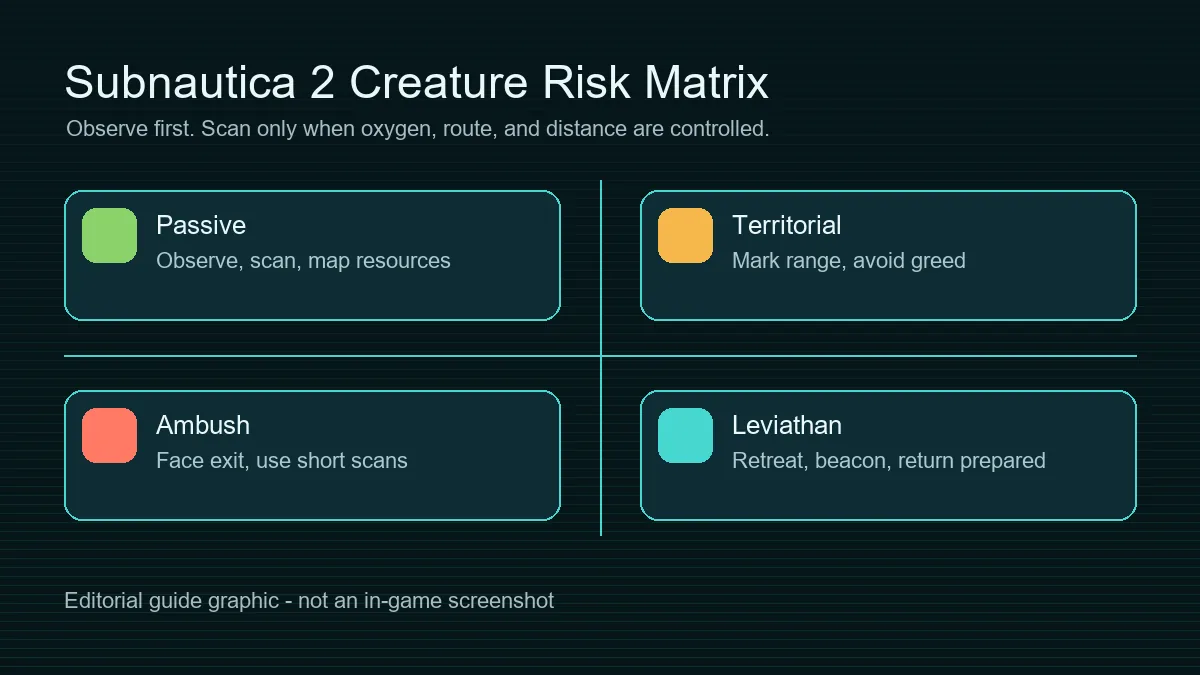
The safest creature system is a mental matrix: distance, visibility, sound, route width, oxygen, and whether the animal reacts to you or simply exists in the space. A creature with low damage can still kill a run if it pushes you into a cave with no return line. A huge creature can be manageable if you respect its patrol edge and leave before greed takes over.
Low risk: observe and scan
Use passive animals to learn movement speed, visibility, and resource patterns. These scans should happen early because they build confidence without forcing deep risk.
Medium risk: mark and loop
When a creature guards useful resources, do not turn the dive into a fight. Make a short collection loop, leave a beacon, and plan a safer second trip.
High risk: retreat first
Large predators, unknown roars, and narrow ambush spaces are not first-scan targets. Retreat, record the biome edge, and return only with a plan.
Patch risk: verify again
Early Access patches can adjust behavior, resource areas, crash fixes, and creature balance. A good guide should be rechecked after meaningful updates.
Leviathans
How to Think About Subnautica 2 Leviathans Without Spoiling Every Dive
Many players search for every leviathan immediately, but a better guide separates survival advice from discovery spoilers.
Use boundary language first
Instead of naming every possible encounter in the first paragraph, describe the warning signs: deep biome transitions, sustained roars, wide patrol lanes, and empty-feeling water. This helps players survive without flattening the discovery.
Do not scan on first contact
A first leviathan encounter is usually a mapping event. The important data is where it starts, how fast it closes distance, whether it follows vertically, and where safety begins. The scan can wait.
Prepare a return kit
Bring enough oxygen margin, a clear beacon name, spare batteries where possible, and a repair habit for vehicles or tools. A risky creature becomes less chaotic when the escape routine is already rehearsed.
Keep spoilers optional
If you are playing with friends, agree whether creature names, locations, and jump-scare moments should be announced. Co-op can accidentally spoil the best survival moments for slower explorers.
Encounter Plan
A Safer Four-Step Plan for New Creature Encounters
Use this routine for unknown creatures, especially when you are entering a new biome or playing co-op with mixed experience levels.
Stop at the edge
Do not swim straight into the center of an unfamiliar creature space. Hold the edge, look for exits, check oxygen, and watch whether the creature reacts to your distance, light, or movement.
Name the escape route
Before scanning, decide the exact direction you will leave. In co-op, say the beacon or landmark aloud so everyone can regroup if the creature scatters the team.
Scan in short windows
Treat the scan as a series of attempts rather than one heroic push. If the creature turns, the sound cue changes, or oxygen drops below your comfort line, break off and come back.
Write down behavior, not only names
A bestiary entry is useful, but your own notes about patrol range, safe angles, nearby resources, and patch version will help more on the next dive.
Scanning
What to Record in Your Personal Creature Log
The in-game scan gives the official entry, but a player log turns that information into a route plan. The most valuable notes are practical: where you saw the creature, what you were carrying, how much oxygen was left, whether it followed, and what resource or story lead tempted you into the area.
Early Access
Creature Information That Can Change During Early Access
Subnautica 2 is designed to evolve through player feedback, so creature guidance should stay conservative where official details may shift.
| Topic | Safe claim | Update action |
|---|---|---|
| Creature names | Use names that are visible in game or official patch notes; avoid treating datamined or rumor names as final. | Recheck names after content updates and keep spoiler-heavy details optional. |
| Aggression and balance | Behavior can change in hotfixes, especially when community feedback targets creature balance. | Retest risk levels after patches instead of copying old danger ratings. |
| Resource areas | Creature risk often depends on what resources the player is trying to reach. | Update route advice when resource areas or spawn density change. |
| Co-op encounters | A creature that is easy solo can become chaotic when several players scatter in different directions. | Add group-specific notes for beacon names, role calls, and retreat routines. |
Next Guides
Plan Your Next Subnautica 2 Dive
Use these pages after checking creature risk so your route, hardware, and co-op plan match the encounter you want to attempt.
Collector Leviathan location and scan guide
Internal
Subnautica 2 Leviathan list and locations
Internal
Subnautica 2 map and biome route guide
Internal
Subnautica 2 multiplayer co-op guide
Internal
Subnautica 2 system requirements
Internal
Subnautica 2 Scanner Station guide
Internal
Unknown Worlds Early Access updates
Official
FAQ
Subnautica 2 Creatures FAQ
Does Subnautica 2 have leviathans?
Players should expect major large-creature threats in a Subnautica sequel, but exact names, spawn areas, and balance should be verified in the current Early Access build. Treat leviathan pages as spoiler-sensitive and patch-dependent.
What is the safest way to scan a hostile creature?
Start from the edge of its range, face your exit, keep oxygen margin, and scan in short attempts. If the creature turns toward you or the soundscape changes, leave and return with better preparation.
Are creature behavior lists final?
No. Early Access updates can adjust behavior, resource areas, spawn density, and balance. Recheck official patch notes and your own in-game observations after each meaningful update.
Should co-op groups split up to scan faster?
Only after the group has beacons, oxygen margin, and a meeting routine. In unknown predator zones, one scout and one support player are safer than four people scattering at once.
Why does this guide avoid a full spoiler list?
Creature discovery is part of the survival experience. This guide gives behavior-first survival advice while keeping exact encounter spoilers easier to avoid.
What keywords should this creature guide not replace?
This page is for creature behavior, scanning safety, leviathan risk, and spoiler-light encounter planning. It should not replace the multiplayer guide, system requirements page, or a future full map database.